
Research Blog
My Research on Experimental Condensed Matter Physics
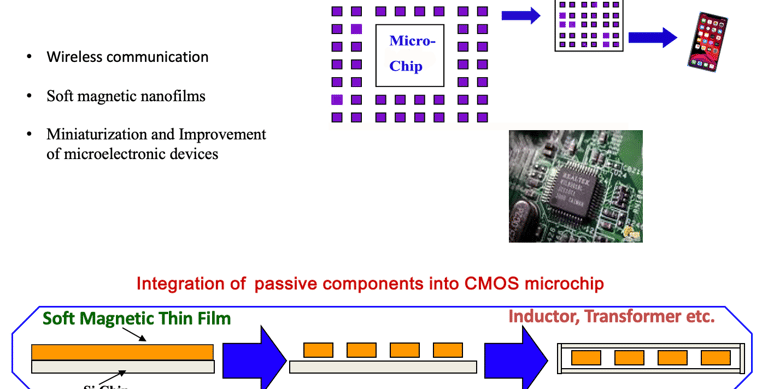
During my PhD in physics, I developed and studied soft magnetic thin films prepared by aligned ellipsoidal iron core-shell nanoparticles. Recently, there has been a significant increase in the research and development of miniaturized electronic devices aimed at enhancing and advancing high-frequency wireless communications in the GHz frequency range. As technology continues to move toward smaller and more efficient devices, understanding the behavior of materials at the nanoscale becomes increasingly important. Owing to the increasing demand for soft magnetic nanofilms for their potential application in high-frequency applications, my research explores how the soft magnetic nanofilms assembled by Fe-Fe₃O₄ core-shell nanoparticles could be one of the most suitable candidates for the desired high-frequency magnetic properties, combining the high 𝑀𝑠 of the Fe core with the high 𝜌 from the semiconductive Fe₃O₄ shell.
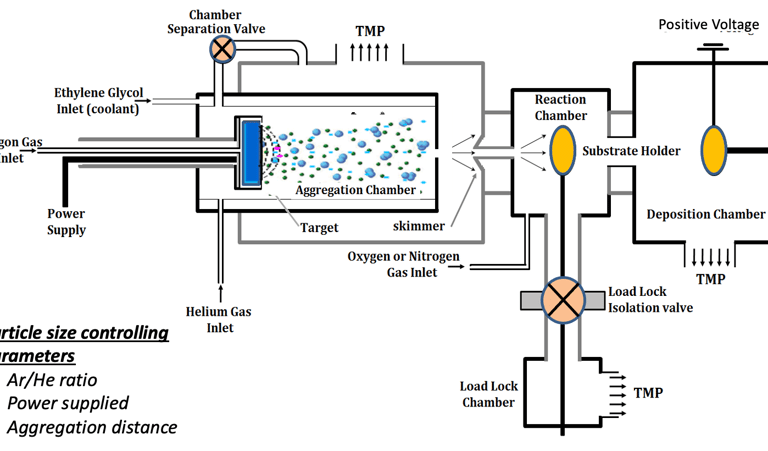
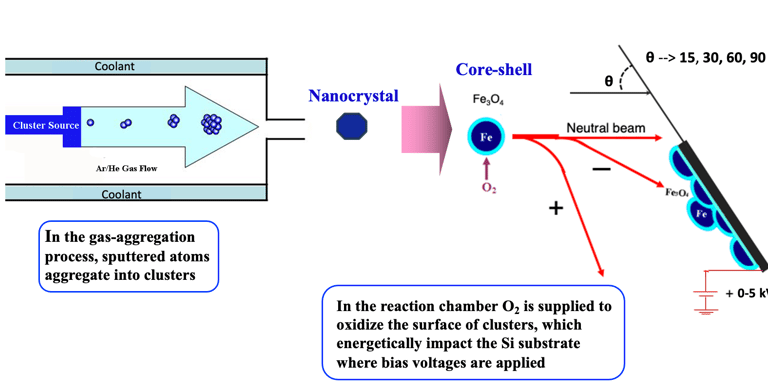
My research primarily involved the fabrication of thin films using the Physical Vapor Deposition (PVD) technique. In my research, Iron/Iron-Oxide core shell nanofilms were prepared by using the combination of magnetron sputtering and gas aggregation technique. This system consists of three chambers, the aggregation chamber, reaction chamber, and deposition chamber. In the aggregation chamber, the Fe nanoparticles aggregate to form Fe nanoclusters. Fe nanoclusters then react with oxygen to form an Fe-Fe₃O₄ core-shell nanostructure, which finally deposits to form Fe-Fe₃O₄ core-shell nanofilms at the deposition chamber. But here in my research, the deposition chamber is held with the substrate holder tilted with different angles (15, 30, 60 and 90 degrees) with respect to the incident beam, where the negatively charged particles are accelerated as a positive potential up to 5 kV is applied to the substrate. The negative particles are then deposited on the substrate held at different angles simultaneously with the high-energy impact.
One of the key aspects of my research was examining how deposition parameters like oblique angle and impact energy influence nanofilm properties. In particular, I investigated the effect of deposition angle and energy on the morphology and magnetic and electrical properties of the thin films. When nanoparticles are deposited onto a substrate, their momentum and impact energy can strongly influence the growth of the structure and shape of the nanoparticles.
Why Nanomaterials Are Important for Future Electronics
In recent decades, electronic devices have become smaller, faster, and more efficient. From smartphones and laptops to advanced computing systems, demand for compact, high-performance devices continues to grow. One of the key factors enabling this technological progress is the development of soft magnetic nanomaterials.
Nanomaterials are materials that have structures at the nanometer scale, typically between 1 and 100 nanometers. At this extremely small scale, materials often exhibit unique physical, electrical, and magnetic properties distinct from their bulk counterparts. These special properties make nanomaterials highly valuable for modern electronic and semiconductor technologies.
One of the major advantages of nanomaterials is their ability to support device miniaturization. As electronic components become smaller, engineers must carefully design materials that maintain performance while occupying less space. Nanomaterials enable researchers to control structural features at the atomic and nanoscale levels, thereby improving the efficiency and reliability of electronic devices.

RESEARCH Experience
Project Name: Soft Magnetic Nanofilms Produced by Aligned Ellipsoidal Fe-Fe3O4 core-shell nanoparticles. (PhD Dissertation Research Project)
Institution: University of Idaho, Moscow, ID
Advisor: Dr. You Qiang
Assumed accountability in organizing, executing, and evaluating experiments to enhance fabrications of iron oxide, core-shell iron oxide nanoparticles through magnetron sputtering techniques
Conducted an investigation on voltage-induced morphology, crystal structure, phase, and magnetic properties of the iron-based magnetic nanoparticles for their application as a high-frequency wireless communication
Analyzed the nanoparticles' size distribution based on several factors, such as vacuum pressure, gas flow rate, and power supply.
Modified the state-of-the-art nanoparticle deposition system for the deposition of the iron/iron oxide cluster impact at different voltages
Investigated the structure-magnetic property relationship of the soft magnetic composites assembled by iron/iron oxide cluster impact at different voltages
Performed statistical analysis on the size distribution of the iron nanoparticles on the different parameters such as vacuum pressure, gas flow rate, and power supply
Performed RMS roughness analysis of the soft magnetic composites assembled by iron/iron oxide cluster impact at different voltages
Utilized AutoCAD in designing machine drawings for various parts of the magnetron sputtering system
Performed a Simion simulation to visualize the trajectory of ions at different voltages
Maintained compliance with safety, security, and environmental regulations while handling chemicals in the lab
Partnered with the following in fulfilling key tasks:
— Different research collaborators and other groups for characterization (structural and electric imaging), data analysis, and manuscript writing
— Equipment supplier technicians to mitigate issues in turbomolecular pump (TMP), AFM, and VSM; and
— Machine shop technician to create and change parts of the magnetron sputtering system toward a state-of-the-art cluster deposition system improvement
Facilitated training to one new graduate and Four undergraduates in condensed-matter research laboratory